The Screenshot Hoarder, the One-Note Wonder, and You: A Field Guide to Your Note Personality
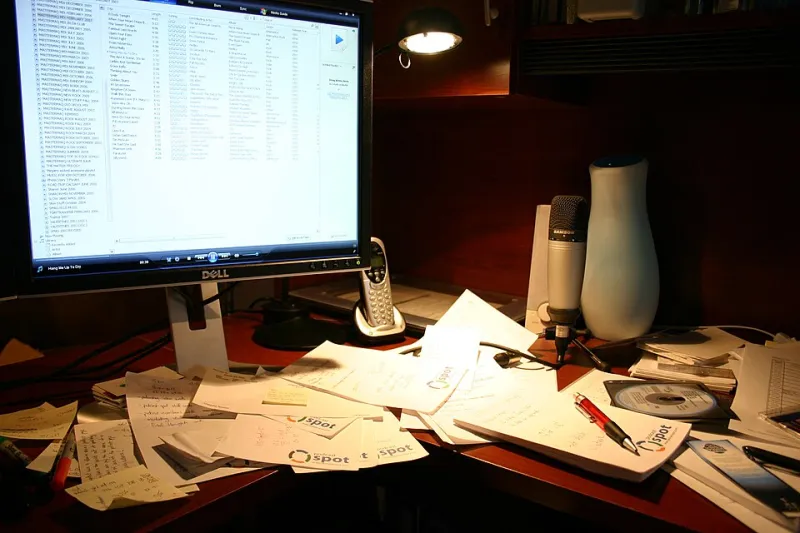
Photo: Mack Male from Edmonton, AB, Canada, CC BY-SA 2.0, via Wikimedia Commons
Everyone's got a note-taking tell. Mine is a Camera Roll with 4,000 screenshots of things I swore I'd read — parking signs, whiteboards, half a recipe for chili. Yours might be a single untitled note called "notes" that's been running since 2019, a digital junk drawer with no bottom.
Whatever your version is, it's not random. The way you capture information maps pretty cleanly onto how your brain prefers to process it — and once you know your type, fixing the downstream chaos gets a whole lot easier.
So here's the field guide. Find yourself, take your lumps, grab your fix.
The Screenshot Hoarder
The tell: Your photos app is 60% images of other people's screens. You have screenshots of screenshots.
What it says about you: You're a visual-first thinker who trusts images over words — which is legit. Research on dual coding suggests pictures genuinely stick better for a lot of people. The problem isn't capturing, it's that screenshots are where information goes to die. There's no search, no structure, no context. That photo of a coworker's project timeline means nothing to you in three weeks.
The fix: Pick one day a week — Sunday night works well, right before the reset crowd gets going — and triage. Anything worth keeping gets transcribed or moved into a proper note with a keyword or two. Anything else gets deleted. A screenshot with no searchable text is basically a sticky note in a hurricane.
The One-Note Wonder
The tell: Every thought, grocery list, meeting agenda, and passive-aggressive reminder to call the DMV lives in a single endless note. Scroll long enough and you'll hit something from the before times.
What it says about you: You value momentum over structure. You'd rather capture fast than file right — a totally reasonable trade-off in the moment. But a single mega-note has a shelf life. Cognitive load research is pretty clear that we retrieve information better when it's chunked, and a 40,000-word scrollback is the opposite of chunked.
The fix: You don't have to abandon the stream — just break it up by theme. One note for work, one for home, one for the half-finished ideas. Three containers, not forty. If your app supports headings and internal links, use them like bookmarks so you can jump instead of scroll.
The Abandoned Folder Tree
The tell: You spent one glorious Saturday building a nested folder system worthy of a library science degree. You have used it twice.
What it says about you: You're a planner who gets energized by systems but bored by maintenance. Classic. The architecture was the fun part; the filing is the chore. The trouble is that empty structure can be worse than no structure — it creates guilt every time you open the app and see "Projects/2025/Q1/Client_Stuff" gathering dust.
The fix: Flatten it. Ditch the deep hierarchy in favor of tags or a simple two-layer setup. Search is good enough now that elaborate folders mostly perform organization rather than provide it. Keep the tree if it makes you happy — but make it three branches, not thirteen.
The List of Lists
The tell: You have to-do lists inside to-do lists. Some tasks have subtasks that have subtasks. Nothing gets checked off, but everything is beautifully itemized.
What it says about you: You're a maximizer — you want the plan to be complete before you act, so you keep planning. Psychologists call this productive procrastination when it gets out of hand, and honestly, the list-making feels like progress, which is exactly the problem.
The fix: Cap it. Three tasks per day, written the night before. If a task needs three levels of nesting, it isn't a task — it's a project, and it needs its own note with a next step.
The Ghost Writer
The tell: You take meticulous notes in every meeting... and never open them again. The act of writing is the whole ritual.
What it says about you: Good news — this one's actually supported by science. Studies on the "generation effect" show that writing things down helps encode them, even if you never reread. Your notes are doing double duty as memory glue. The only waste is when you do need to look something up and can't find it.
The fix: Add a 30-second summary line at the top of each note — what happened, what's next. That's the only part you'll ever need to reread, and future-you will be grateful it exists.
So Which One Are You?
Quick self-check — count your yes answers:
- More than 200 screenshots in your camera roll right now?
- One note older than your last phone upgrade?
- A folder system you built with love and abandoned with speed?
- A to-do list with nesting deeper than a Russian doll?
- Notes from a meeting you can't actually remember attending?
Three or more yeses and, well, welcome to the club — most of us are hybrids, usually a Hoarder-Wonder combo with a side of abandoned folders.
The point isn't to feel bad about any of this. Every one of these habits starts as a genuinely smart adaptation to how your brain works. It just needs a guardrail. Pick the fix for your dominant type, run it for two weeks, and see if your notes start working for you instead of just piling up behind you.
And if all else fails? There's always the nuclear option: delete something every day and see what you actually miss. Spoiler — it's usually less than you'd think.